Navigating the Fiction of Ernest J. Gaines by Keith Clark
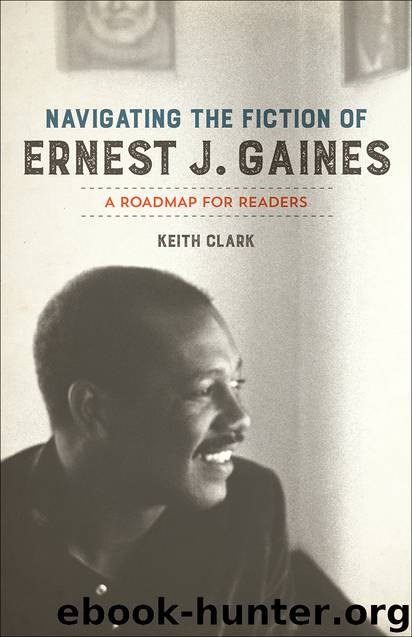
Author:Keith Clark
Language: eng
Format: epub
Publisher: LSU Press
Published: 2020-05-14T16:00:00+00:00
The African America folk heroic tradition allows for the sometimes ambiguous and questionable nature of African American heroic actions and African American heroic figures. Work for the common good outweighs individual fault within that work. Moral lapses, even (or especially) from ministers, are simply something to which African Americans are accustomed. If they do not embrace such actions, they simultaneously do not call the perpetrator evil and turn permanently away from him. (19)
Thus, Phillip’s exalted status as God’s sacred ambassador and secular leader exposes a tendency among many such figures to see their rampant materialism as permissible—just desserts for their efforts on behalf of their various constituencies. His opulent lifestyle, evidenced by his bejeweled fingers and other extravagant gewgaws, is recognizable to readers familiar with actual pastors who, as Harris’s assessment suggests, are extolled so much for their communal good works that their intemperate spending is either ignored or, in some quarters, even celebrated. Gaines dramatizes the material chasm separating father and son most vividly in the quality of the men’s garments: while Robert X dons “a wrinkled brown shirt and wrinkled brown slacks” (Father’s House 24), his father is resplendent in “a black pinstriped suit, a light gray shirt, and a red polka-dot tie” (34). But Reverend Martin’s lifestyle also raises nagging questions about the objectives of the movement he spearheads: is its purpose to provide St. Adrienne residents access to economic and political opportunities and power to elevate the collective, or is its objective to transform blacks into individually driven consumers who gorge themselves on cars and houses and other accoutrements of a vacuous American Dream?
In addition to identifying the potential for rampant consumerism as an implicit pitfall in African Americans’ quest for equality, Gaines further problematizes Phillip’s outsized sense of self through the near godlike power he asserts as his prerogative. While such power wielded in the service of the community may, as Harris posits, spare the heroic figure communal judgment, such unrestrained privilege may auger a god complex, where one’s personal breaches are minimized if not outright dismissed. Such a whitewashing of one’s own foibles by claiming a greater proximity to the Divine can potentially be used to excuse heinous acts committed against others. Perhaps the most striking instance of Phillip’s self-proclaimed godhead status occurs when he attempts to explain how he has atoned for his earlier life of libidinal indulgence, embodied in the disowned firstborn who now craves retribution. After being struck down by Robert X’s gaze, Phillip retreats to his office and pleads with his Father in less than humble—if not outright accusatory—fashion: “Why? Why? Why? Is this punishment for my past. Is that why he’s here, to remind me? But I asked forgiveness for my past. And You’ve forgiven me for my past” (69). His self-piety becomes more pronounced when he faces Robert X’s wrath, in their only one-on-one encounter.
Deflecting his son’s multiple accusations, Phillip insists that he’s done sufficient penance and declares himself redeemed: “I’m a man today. I prayed for Him to make me a man, and He made me a man.
Download
This site does not store any files on its server. We only index and link to content provided by other sites. Please contact the content providers to delete copyright contents if any and email us, we'll remove relevant links or contents immediately.
| African | Asian |
| Australian & Oceanian | Canadian |
| Caribbean & Latin American | European |
| Jewish | Middle Eastern |
| Russian | United States |
4 3 2 1: A Novel by Paul Auster(12424)
The handmaid's tale by Margaret Atwood(7784)
Giovanni's Room by James Baldwin(7369)
Big Magic: Creative Living Beyond Fear by Elizabeth Gilbert(5790)
Asking the Right Questions: A Guide to Critical Thinking by M. Neil Browne & Stuart M. Keeley(5789)
Ego Is the Enemy by Ryan Holiday(5468)
The Body: A Guide for Occupants by Bill Bryson(5113)
On Writing A Memoir of the Craft by Stephen King(4958)
Ken Follett - World without end by Ken Follett(4749)
Adulting by Kelly Williams Brown(4588)
Bluets by Maggie Nelson(4576)
Eat That Frog! by Brian Tracy(4558)
Guilty Pleasures by Laurell K Hamilton(4471)
The Poetry of Pablo Neruda by Pablo Neruda(4120)
Alive: The Story of the Andes Survivors by Piers Paul Read(4042)
White Noise - A Novel by Don DeLillo(4021)
Fingerprints of the Gods by Graham Hancock(4017)
The Book of Joy by Dalai Lama(4001)
The Bookshop by Penelope Fitzgerald(3860)
